Jamaica Hospital Opens New Pediatric Treatment Room

Anyone who has ever been a patient in a hospital will tell you that the experience can be unsettling, especially for children. In an effort to make the experience for children a little more pleasant, Jamaica Hospital recently opened a state-of-the-art pediatric treatment room.

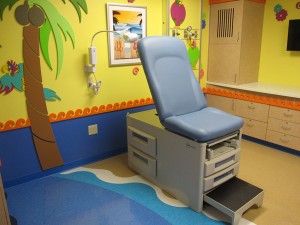
The new treatment room has a tropical beach motif, with palm trees, dolphins playing in the surf and parrots flying high in the sky. The bright colors and wonderful artwork will not only make a remarkable difference for children but the physicians and nurses will have an easier time locating supplies. The treatment room also features strategically designed organization, better lighting, and an upgraded exam table.

A wide variety of procedures will be performed in the treatment room, including IV starts, blood collection, cauterizations, IV flushes, injections, hearing and sight testing, OB exams, and consultations.

Jamaica Hospital’s Pediatric Department is thrilled about the new feature of it’s Pediatric Unit. Staff members are excited about the room’s ability to serve as a distraction for children while they undergo medical care. Above all, they are thankful for the generous donations provided by the Starlight Children’s Foundation and the Larry and Jane Scheinfelf Foundation, whose funding helped build the new room.

Jamaica Hospital Warns the Community About Bicycle Safety

There has been a great deal of attention recently given to the relationship between brain injuries and sports. Most of the focus has been on the cumulative effects of concussions and violent, contact sports such as football, but surprisingly many non-contact sports and recreational activities have a higher incidence of brain injuries, with cycling having the highest numbers.

With summer practically upon us, the brain injury experts at Jamaica Hospital’s Traumatic Brain Injury (TBI) Unit are determined to warn the community about the potential dangers associated with cycling, as well as identify the signs and symptoms of concussive injuries.

In two separate interviews, with the Queens Chronicle and the Times Ledger newspapers, Dr. Gonzalo Vasquez-Casals, Neuro-Psychologist pointed out that of the 446,000 sports-related brain injuries treated at hospital in 2009, 85,000 or roughly 20% were due to cycling.

In the Times Ledger article, which appeared on May 3rd, Dr. Vasquez-Casals informed readers that headaches, confusion, disorientation, dizziness, slurred speech, nausea, vomiting, and fatigue are potential signs of a concussion.

In the article, which ran in the Queens Chronicle on April 29th, Dr. Vasquez-Casals warned riders that helmets are the best way to safeguard against cycling injuries.  According to Dr. Vasquez-Casals, “97% of all fatal accidents involving bicycles are due to brain injuries when a rider wasn’t wearing a helmet.”

Dr. Vasquez-Casals was very hopeful that the message was well received and that cyclists in the community will enjoy a fun and safe summer on the bike paths.

Jamaica Hospital Extends Visiting Hours

In an attempt to create a more visitor friendly environment, Jamaica Hospital’s leadership recently decided to extend the hospital’s visiting hours.

The old visiting policy was not only limiting but also confusing because many of the units had different visitation schedules.  As a result, leaders from Administration, the Nursing Department, Building Services, Security and Admitting/Information Desk met and agreed to extend visiting hours on all floors.

Effectively immediately, visiting hours will now begin at 9:00 a.m. on all medical/surgical, intensive care, OB/GYN and pediatrics units. Visiting hours on all floors will end at 8:00 p.m.

The only unit that has not extended visitation is 5 North (Rehab, TCU, and TBI). This decision was made so that the patients on this unit can continue to receive uninterrupted daytime rehabilitation services.

Other enhancements of the new visiting policy include new age permissions on all units. Previously, Jamaica Hospital did not allow any children 16 years of age or under on the medical surgical floors.  Now, all children 12 and older can visit family members on any unit and siblings of any age can visit patients on 2 North and 2 South.

The Nursing Supervisors will continue to help those visitors who need special accommodations, such as rooming-in needs and comfort care passes.  They will also work on a case-by-case basis with visitors who require other special arrangements.

The hospital hopes that the changes will communicate to our patients and visitors our dedication to improving the quality of their stay.  We understand the difficulties some people have making it to the hospital when there are restrictions and we hope these measures are helpful.

New passes have been printed and the revised policy will be updated on all signs and other materials.

Jamaica and Flushing Hospitals Launch New Advertising Campaigns

Jamaica and Flushing Hospitals have recently launched new advertising campaigns to inform the communities they serve about their exceptional services and their unyielding commitment to their health.

Jamaica Hospital’s “All Roads Lead to Jamaica Hospital’ is a concept that focuses on the locality of the hospital and its strong presence in the community. It also reminds its neighbors of some of its outstanding services, including Emergency Medicine, Cardiology, OB/GYN, Radiology, and Pulmonary Medicine.  Flushing Hospital’s “You’re Welcome” concept is centered on the warm and welcoming atmosphere the hospital has created and maintained throughout the years. It also highlights the compassionate care and diverse services it offers.

“Our goal is to ensure these communities that we have a comprehensive range of services that meet the needs of everyone—from infants to adults to seniors—and that we offer these services in a friendly and caring environment ,” said Michael Hinck, Director of Public Affairs at Jamaica and Flushing Hospitals.

The brightly-colored and eye-catching ads can be seen in several local community newspapers, including The Queens Courier, The Queens Tribune, and The Queens Chronicle. The advertising campaigns will run through the end of the year.

To see each ad individually, please click on the following links:

JHMC-All Roads Ad

FHMC-You are Welcome Ad

Jamaica Hospital Celebrates National Trauma Awareness Month

“If You’re Distracted, We’re Impacted” was this year’s theme for National Trauma Awareness Month and to help spread the message about the seriousness of distractions, Jamaica Hospital’s Trauma Division recently set up a distracted driving community education display in the hospital lobby.

On May 23, members of Jamaica Hospital’s trauma team distributed literature to hospital
employees and visitors to help educate them on the dangers of distracted driving and how
 to stay safe.“There are many dangers while driving,” said Mark Dekki, MPA, Community Educator, Trauma Services at Jamaica Hospital. “Not only does a distracted driver jeopardize their own life, but the lives of those in the car with them, as well as the lives of other drivers who are sharing the road and the lives of pedestrians.”

Distracted driving is characterized as any activity that could divert a person’s attention away from the primary task of driving. These actions can include eating, applying make-up, playing loud music, talking to passengers, and texting while driving, which over the last few years has become a cause of major concern.

According to the National Highway Traffic Safety Administration, 16% of fatal crashes and 20% of injury crashes in 2009 involved reports of distracted driving. In general, distracted driving contributes to up to 8,000 crashes every single day.  Additionally, at any given moment during the daylight hours, over 800,000 vehicles are being driven by someone using a handheld cell phone. Drivers who use hand-held devices are four times as likely to get into crashes serious enough to injure themselves.

“Distracted driving is one of the leading causes of death in Queens,” explained Dekki. “It is our greatest hope that this informational event gave people a better understanding of the dangers of being a distracted driver and provided enough of an impact to encourage a change in their behavior.”

As a Level 1 Trauma Center, Jamaica Hospital treated 717 trauma patients in its emergency department in 2012, of which 82 were pedestrians struck and 108 were motor vehicle traumas.

The National Trauma Institute reports that each year, trauma accounts for 42 million emergency department visits and two million hospital admissions across the nation. Furthermore, trauma injury accounts for 30% of all life years lost in U.S., more than cancer, heart disease, and HIV. In fact, the impact on life years lost is equal to the life years lost from cancer, heart disease and HIV combined.

To avoid becoming a trauma statistic, Dekki offers the following to drivers: “staying safe on the road is simple: turn off all electronic devices, apply all make-up before you get in the car, and eat meals and snacks before you get behind the wheel.”


Jamaica Hospital Gets “Creative” With Art Therapy

In recognition of Creative Arts Therapy Week, Jamaica Hospital recently held its first annual exhibition of patient created art work.

The artwork, which was created by patients in Psychiatry units 2 and 3, was displayed in the main lobby of the hospital. Working with the therapists on these units provides patients with the opportunity to express themselves through their art in a way that they normally aren’t able to communicate verbally.

Creative art therapies utilize various art forms (art, music, writing, movement/dance, and drama) to help patients gain insight and awareness into their feelings, thoughts and behaviors in a non-threatening manner. Patients who receive inpatient mental health services participate in several creative arts therapy groups each day.

The displayed artwork was viewed by hundreds of employees, visitors, and patients, many of whom had no idea the program existed.

The hospital extends a special thanks to all staff members who work with these patients on a daily basis and who continually make the program a success.

Jamaica Hospital Trauma Department Hosts Workshop For Seniors

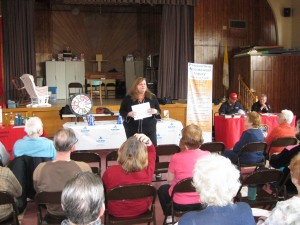
On Friday, April 5th, Jamaica Hospital’s Trauma Department hosted a trauma prevention workshop at the Howard Beach Senior Center.

The purpose of this event was to reach out to Queen’s senior population to educate them on injury prevention, fall prevention, poison prevention, pedestrian safety, and fire prevention and to help decrease the number of preventable trauma/injury related events, therefore decreasing hospital admissions from these preventable injuries.

There were over 50 members of the Howard Beach Senior Center who attended the workshop. The members were extremely engaged in the presentation and were appreciative of the speakers who gave presentations. In addition to the variety of topics that were presented, the seniors were also given brochures, safety tips, and educational materials related to injury prevention.

The event was coordinated by Mrs. Nicolle Tuccillo, MHA, RPA-C/Trauma Program Manager at Jamaica Hospital and Dr. Patricia Gentile, Administrator for Jamaica Hospital’s Trauma Department.

Trump Pavilion Does Well on Annual Survey

Jamaica Hospital’s Trump Pavilion for Nursing and Rehabilitation recently underwent its annual survey by the New York State Department of Health. Gregory Bradley, Executive Vice President of Trump Pavilion, stated “it is required that every nursing home is inspected annually to make sure that they are meeting all of the requirements set forth by the Federal and State Government. Passing the survey allows a facility to remain eligible to receive payments from Medicare and Medicaid.”

The survey was conducted by a team of five surveyors over a period of five business days. Results were reported in two distinct areas–the Life Safety Code phase and the Clinical phase. The Life Safety review is an examination of the physical plant and related systems to ensure that standards pertaining to fire protection, safety, and sanitation are being met.

The Clinical phase of the survey involves interviews with current staff, residents and families, as well as more than 40 extremely detailed random chart reviews, including both current and former residents of the facility. Chart reviews are done to ensure that patient care meets all relevant Federal and State requirements as outlined by the Center for Medicare and Medicaid Services (CMS).

According to Mr. Bradley, “there were no clinical deficiencies found by the survey team. This is an extraordinary outcome as it is not uncommon for the surveying team to find several deficiencies in each nursing home. We are especially proud of the fact that no patient care deficiencies were found during this year’s visit.”

The nursing home, however, was cited for one minor Life Safety deficiency and it was corrected immediately.

Mr. Bradley stated, “We are very pleased with the outcome of this year’s survey and applaud the staff for a job well done.”

Jamaica Hospital’s New Care Transitions Program to Significantly Benefit Hospital and Patients

Jamaica Hospital has recently implemented a Care Transitions Program, a momentous effort to provide proactive medical and social interventions to patients who pose a high risk for hospital readmission. The new program, which also boasts significant financial savings for the hospital, began in 2011 and is comprised of three distinct initiatives- The Intensive Multidisciplinary Primary Care Team (IMPACT) , the Community-Based Care Team (CBCT), and the Hospital Care Transitions Team (CTT).

IMPACT was established to provide long term, managed care to super-utilizers, patients who have repeated in-hospital stays. These patients are followed by a care team made up of a nurse practitioner, a social service case manager, and a community health worker, who work together to assist patients with scheduling their doctor appointments, filling their prescriptions, securing health related services such as home care, obtaining social services, and providing them with education and other health related assistance.

In a 2011 pilot, high utilizers of medical services, who had Neighborhood Health Plan (NHP) Medicaid were chosen to participate in the IMPACT program.  A Care Transitions Team (CTT), which is comprised of a registered nurse and service coordinator who screens patients for either IMPACT or CBCT, used the hospital’s state-of-the art EPIC system to identify potential super-utilizers, patients who had several hospital admissions within a six month period, were diagnosed with one or more of the following disorders—pneumonia, congestive heart failure, diabetes, chronic obstructive pulmonary disease, or end stage renal disease, or myocardial infarction— and met additional health and socioeconomic criteria.

At the conclusion of the year, the patients didn’t experience hospital readmissions and were satisfied with their overall care. Additionally, a reduction in the utilization of services allowed the hospital to save $400,000. Prior to the implementation of IMPACT, these superutilizers would have cost the hospital $700,000, compared to the $300,000 spent during the year-long pilot.

The Community-Based Care teams, which are currently in development, are designed to reach patients who aren’t super-utilizers but are still at risk for hospital readmission because of their health status or other biopsychosocial factors. The teams will monitor 30-40 patients each for up to 29 days. Each team will work closely with the patient’s primary care physician to ensure coordination of health care needs for thirty days post discharge. Health care interventions, such as medication reconciliation, referrals to health care services, and management of medical services, will be provided in the home and/or the community to best meet the needs of the patient.  After the completion of 30 days, patients may be referred to ongoing services in the community, to the IMPACT program, or ongoing monitoring by their primary physician.

“The idea behind our care transitions initiative is to provide interventions in the home to high risk individuals and to reduce the risk of preventable readmissions,” said Dr. Angelo Canedo, Vice President at MediSys Health Network. “Overall, our Care Transitions Program is aimed at cutting 30-day readmissions by at least 20%, which is also aligned with the government’s recent effort to decrease hospital readmissions, and to increase community based/ambulatory care.”

Under the Affordable Care Act, hospitals face financial penalties when a patient is readmitted within 30 days after their discharge. Medicare has also begun penalizing hospital for readmissions. Jamaica Hospital, which serves a population with a high risk for hospital readmissions, has a 25% hospital readmission rate, while the national average rate is 15%.

To ensure that the facility’s readmission goals are attainable, Jamaica Hospital is currently seeking a HEAL grant to develop additional care transition teams, which would allow the hospital to service more patients. Though the hospital is focusing on Medicare fee for service patients, the goal is to expand to other payers in the future.    The development of these programs is just one step the hospital has taken to prepare itself for the future landscape of the healthcare industry.  It’s though the collaboration and cooperation of all employees that these programs will be a great success.