

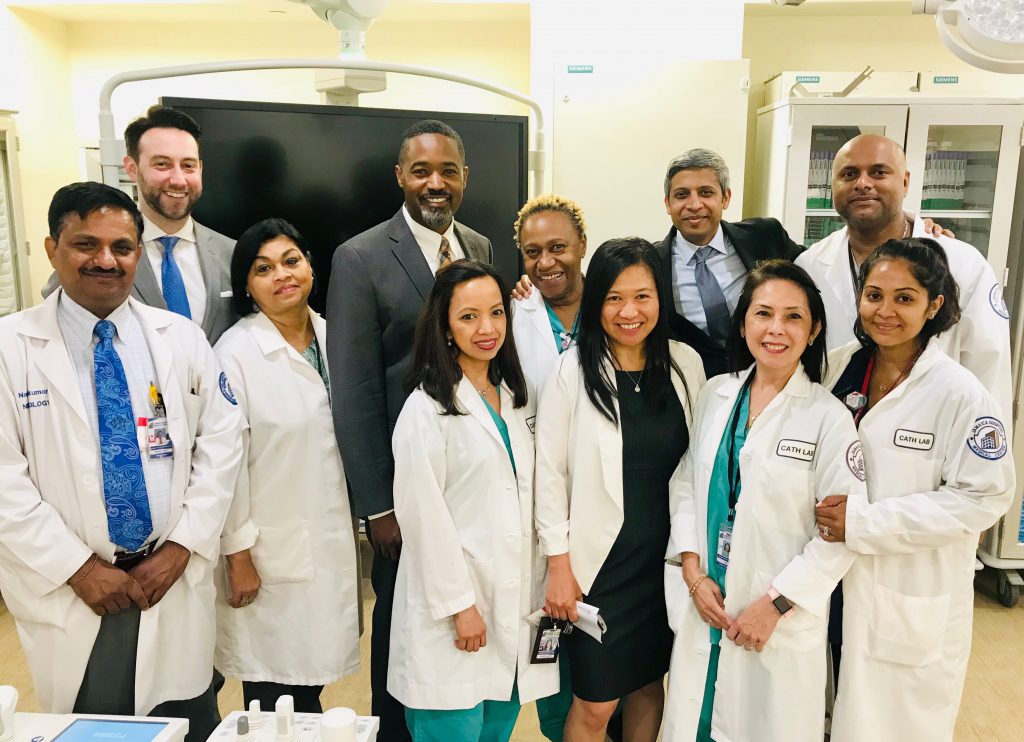
 Jamaica Hospital recently became a designated Thrombectomy-Capable Stroke Center, an advancement in stroke care brought on by the evolving stroke system of care in New York City. This designation was received from the Department of Health, in collaboration with the American Heart Association/American Stroke Association (AHA/ASA) Mission: Lifeline Project Stroke initiative. This designation signifies that Jamaica Hospital has met the rigorous standards for performing mechanical endovascular thrombectomy (EVT), a specialized surgical procedure used to remove a blood clot from the brain during an ischemic stroke.
Stroke is the fifth leading cause of death in the United States but remains to be the number one cause of disability. More than 87 percent of cases are ischemic strokes caused by a clot that cuts off blood flow to a part of the brain. These types of strokes are largely treatable if a patient gets to a hospital that can provide the right treatment in time.
Having this designation demonstrates that Jamaica Hospital is qualified to perform an EVT for all patients who experience a large vessel occlusion (LVO), which is an ischemic stroke that results from a blockage in one of the major arteries of the brain. Prior to having this certification, patients in the 911 system would have to bypass Jamaica and be brought to a thrombectomy-capable hospital, which could delay care and affect outcomes.
Now these procedures can be performed in Jamaica Hospital’s interventional lab. Jamaica Hospital is one of only three hospitals in Queens to have this designation, meaning the hospital will be responsible to provide stroke care to patients throughout the borough and possibly beyond.
Receiving this designation was a major accomplishment that required a great deal of hard work by many. Jamaica Hospital needed to meet strict guidelines, to receive this designation, including committing to neuro-interventional coverage 24 hours a day, seven days a week. In addition to securing around-the-clock coverage, the hospital had to train a number of our medical, emergency department, anesthesia, and nursing staff on new treatment protocols. Abigail Hasan, Stroke Coordinator added, “The acquisition of the biplane unit in our new interventional suite was key in earning this designation. This technology allows our staff to see cleaner and more accurate images of the neurological anatomy, which results in better outcomes.”
Since earning this designation, the hospital team has already responded to many cases with positive results. Abigail recalls a particular case where a patient arrived partially paralyzed due to a stroke and thanks to the efforts of our team regained functionality and was able to eventually walk out of the hospital on their own. “It was truly a great save. The ability to reverse the disability and regain the quality of life inspires our efforts to get stroke patients where they need to be as quickly as possible.”
According to Bruce J. Flanz, President and CEO of Jamaica Hospital, “We are very proud to have earned the Thrombectomy Capable Stroke Center designation. This is yet one more example of Jamaica Hospital’s commitment to providing high quality, person-centered care to our patients.”
 The average American is living longer now than ever before, and while this is very good news, it does require the healthcare industry to adapt to caring for a growing senior population.
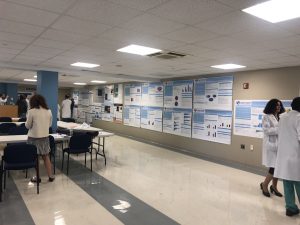 On Friday, May 24th, over 30 research posters and additional published works were displayed in print and electronic forms in Jamaica Hospital’s auditoriums. The following week, on Thursday, May 30th, Flushing Hospital showcased nearly three dozen posters on the walls of the auditorium. All of the posters on display were presented at professional conferences within the last year.
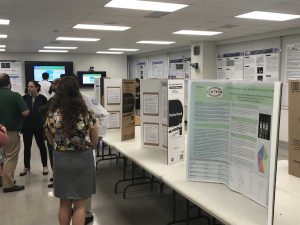 Many passed through and admired the posters at both events, which included submissions from various departments including family and internal medicine, ob/gyn, orthopedics, pathology, pediatrics, psychiatry, pulmonology, surgery, and trauma.
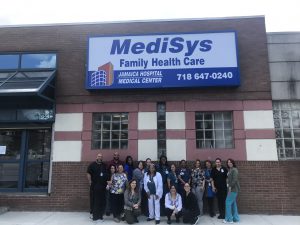 Many women enjoy purchasing and owning a variety of pocketbooks, so it’s not uncommon that after a few years, these accessories begin to accumulate in their closets. When this happens, some are faced with the decision of what to do with their unwanted bags.
 With the permission of Vanessa Lavienas, Manager at MediSys East New York, Margaret and her co-workers set out to collect pocketbooks and financial contributions to buy hygiene products to fill them. Georgeretta Williams, Patient Access Representative, was the organizer of the effort. She collected all the donations and made contact with a local women’s shelter where the pocketbooks could be given to displaced residents. Dozens of employees at MediSys East New York contributed and through their efforts, the group was able to secure enough resources to collect and fill 93 pocketbooks.
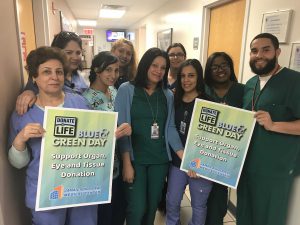 April was National Donate Life Month and once again Jamaica Hospital displayed its commitment to this very worthy effort by participating in a series of events.
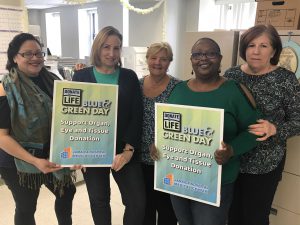 On April 30th, Jamaica Hospital invited members from LiveOnNY to visit and speak with hospital employees. The LiveOnNY team was accompanied by kidney recipient Kenneth Teasley. Mr. Teasley shared his personal experience with employees on many of the hospital’s nursing units and urged them to enroll to become organ donors.
 Jamaica Hospital Medical Center and Flushing Hospital Medical Center are proud to be two of only 12 hospitals chosen to participate in a 24-month collaborative program that will help the MediSys Health Network reach its goal of delivering the highest level of patient-centered care.
 The New York State Department of Health has recently asked hospitals to help treat the growing number of people who have problems with addiction on an inpatient basis.